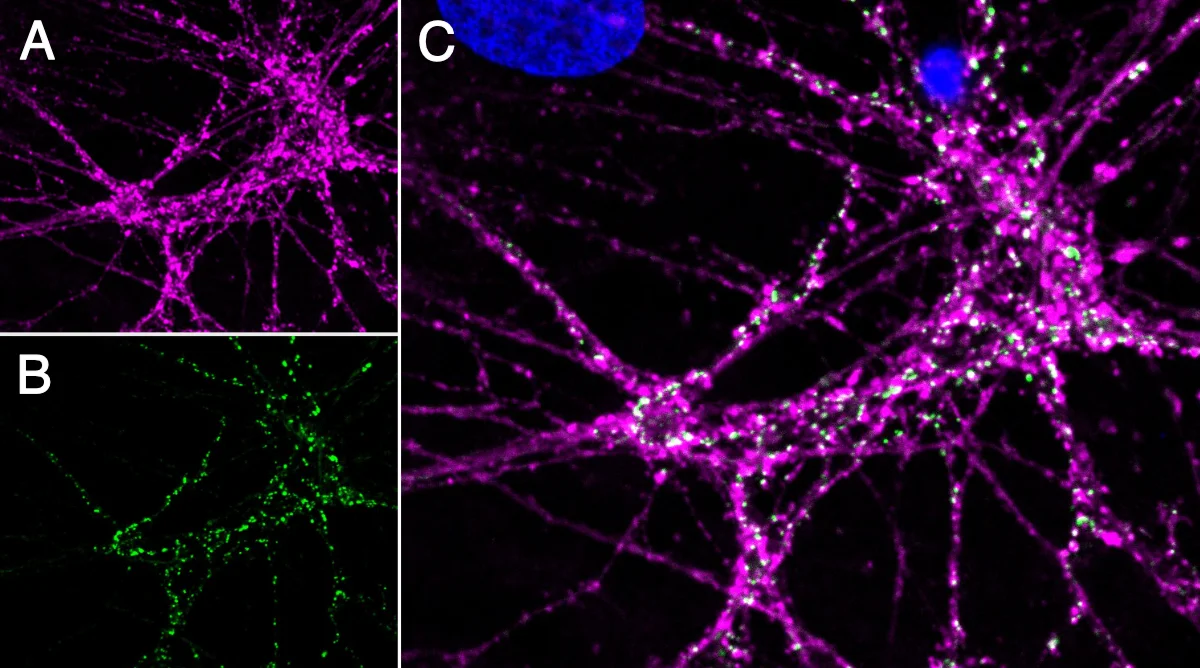
Indirect immunostaining of PFA-fixed rat hippocampal primary neuronal cultures. A Staining of neurons with Recombinant anti-Syt1 Cytosolic Domain antibody (7A51) Mouse IgG1 Fc-fusion (Cat. No. N4382, 1:1000), detected with Smart Secondary® – FluoTag®-X2 anti-Mouse IgG1 Alexa647 (Cat. No. N2002-AF647, 1:1000; magenta). B Co-staining with FluoTag®-X2 anti-PSD95 Atto488 (Cat. No. N3702-At488, 1:1000; green). C Merge of A and B with DAPI signal for nuclei (blue).
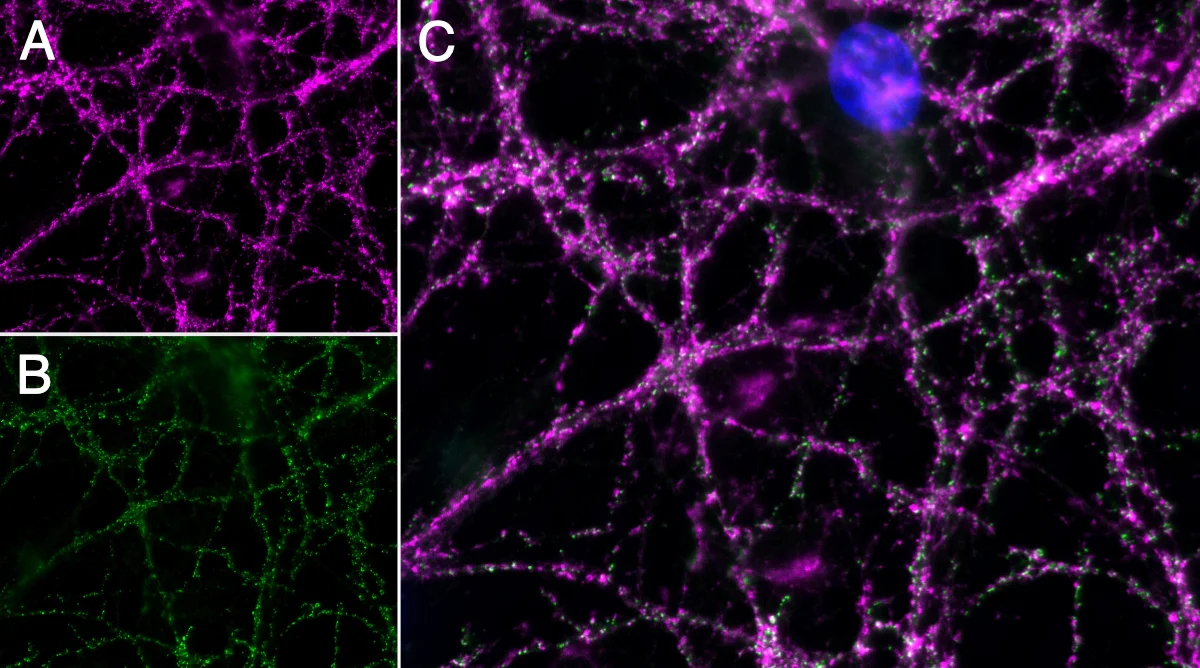
Indirect immunostaining of PFA-fixed rat hippocampal primary neuronal cultures. A Staining of neurons with Recombinant anti-Syt1 Cytosolic Domain antibody (7A51) Mouse IgG1 Fc-fusion (Cat. No. N4382, 1:1000), detected with Smart Secondary® – FluoTag®-X2 anti-Mouse IgG1 Alexa647 (Cat. No. N2002-AF647, 1:1000; magenta). B Co-staining with FluoTag®-X2 anti-PSD95 Atto488 (Cat. No. N3702-At488, 1:1000; green). C Merge of A and B with DAPI signal for nuclei (blue).

Indirect immunostaining of PFA-fixed sagittal rat hippocampus section using Recombinant anti-Syt1 Cytosolic Domain (A51) antibody Mouse IgG1 Fc-fusion (Cat. No. N4382, 1:1000), detected with Smart Secondary® – FluoTag®-X2 anti-Mouse IgG1 AZDye568 (Cat. No. N2002-AF568, 1:500; red). Cell nuclei are counterstained with DAPI (blue). Scale bar: 50 µm.
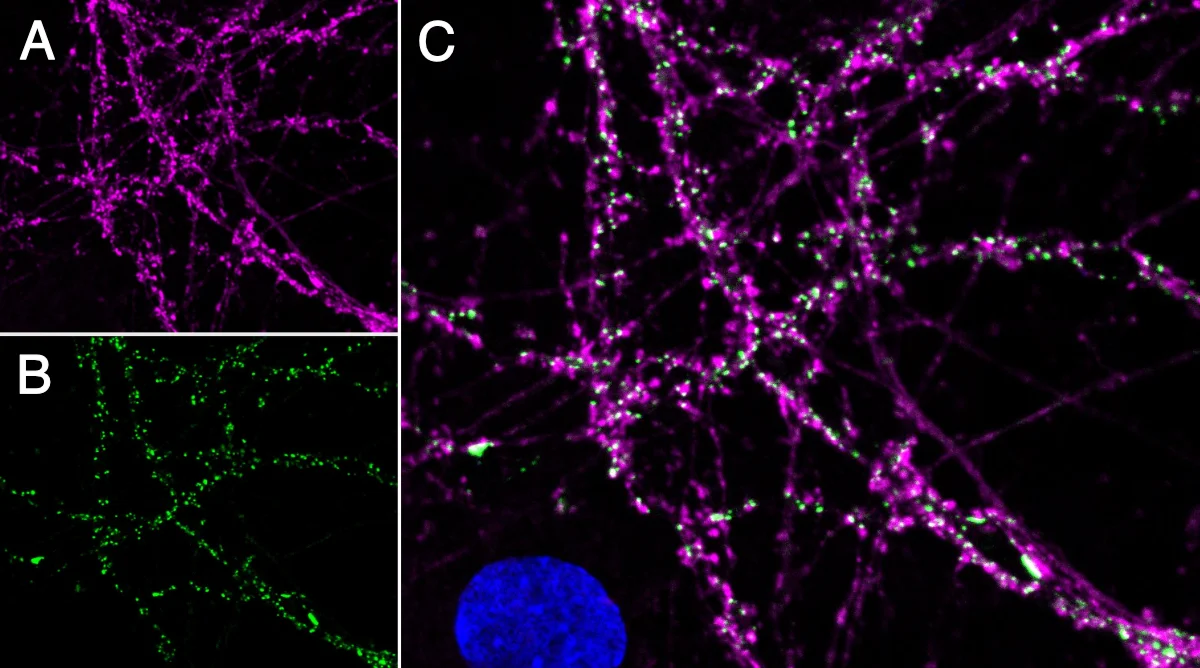
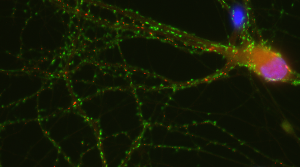
Indirect immunostaining of PFA-fixed rat hippocampal primary neuronal cultures. A Staining of neurons with Recombinant anti-Syt1 Cytosolic Domain antibody (A51) Rabbit IgG Fc-fusion (Cat. No. N4383, 1:1000), detected with Smart Secondary® – FluoTag®-X2 anti-Rabbit IgG Alexa647 (Cat. No. N2402-AF647, 1:1000; magenta). B Co-staining with FluoTag®-X2 anti-PSD95 Atto488 (Cat. No. N3702-At488; 1:1000; green). C Merge of A and B with DAPI signal for nuclei (blue).
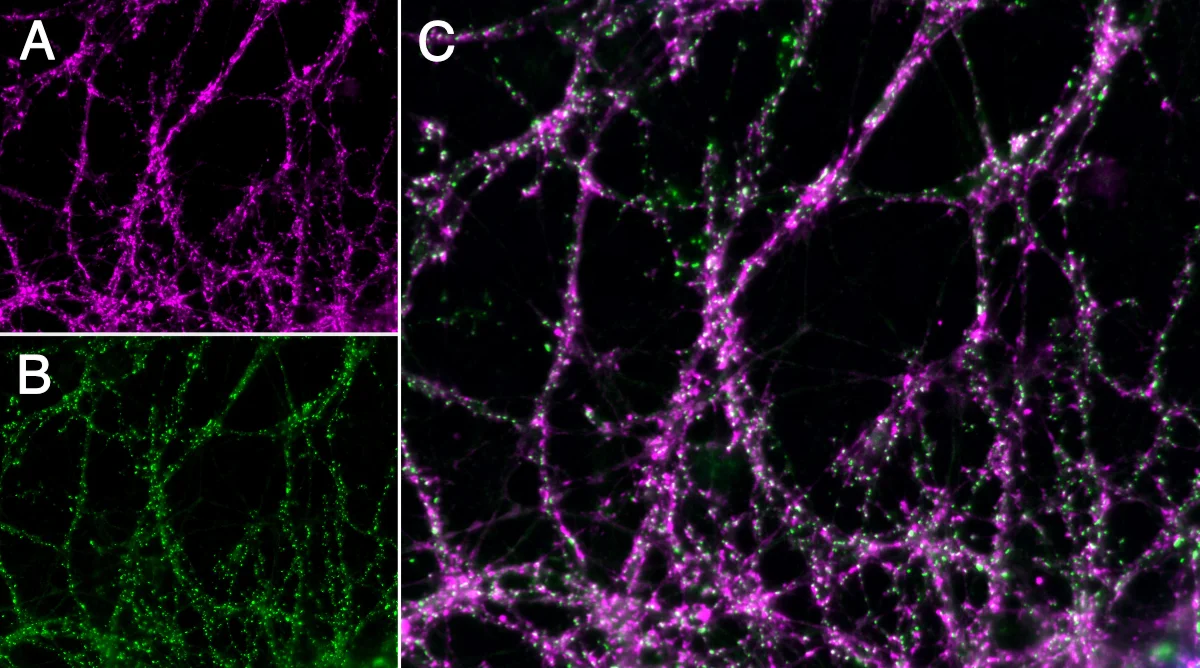
Indirect immunostaining of PFA-fixed rat hippocampal primary neuronal cultures. A Staining of neurons with Recombinant anti-Syt1 Cytosolic Domain antibody (A51) Rabbit IgG Fc-fusion (Cat. No. N4383, 1:1000), detected with Smart Secondary® – FluoTag®-X2 anti-Rabbit IgG Alexa647 (Cat. No. N2402-AF647, 1:1000; magenta). B Co-staining with FluoTag®-X2 anti-PSD95 Atto488 (Cat. No. N3702-At488; 1:1000; green). C Merge of A and B with DAPI signal for nuclei (blue).

Indirect immunostaining of PFA-fixed sagittal rat hippocampus section using Recombinant anti-Syt1 Cytosolic Domain (A51) antibody Rabbit IgG Fc-fusion (Cat. No. N4383, 1:1000), detected with Smart Secondary® – FluoTag®-X2 anti-Rabbit IgG AZDye568 (Cat. No. N2402-AF568, 1:500; red). Cell nuclei are counterstained with DAPI (blue). Scale bar: 50 µm.


Recombinant anti-Syt1 Cytosolic Domain antibody (A51) rHcAb
420,00 €


The recombinant heavy-chain anti-Syt1 Cytosolic Domain antibody (A51) is a genetic fusion of our camelid anti-Synaptotagmin 1 single-domain antibody (sdAb) to either a Mouse IgG1 or a Rabbit IgG Fc domain. It specifically recognizes rat, mouse and human Syt1.
The recombinant heavy-chain anti-Syt1 Cytosolic Domain antibody (A51) is a genetic fusion of our camelid anti-Synaptotagmin 1 single-domain antibody (sdAb) to either a Mouse IgG1 or a Rabbit IgG Fc domain. The resulting bivalent binders combine the high target specificity of sdAbs with maximal flexibility and coherence needed for Fc-domain-based applications. The antibody has the specificity of the anti-Synaptotagmin 1 nanobody clone #A51 (fully characterized here) and recognizes the cytoplasmic domain of rat, mouse, and theoretically also human Synaptotagmin 1. It can be detected using conventional secondary reagents or with our secondary nanobodies (Smart Secondaries®), which offer advantages in applications where secondary antibody clustering is a concern or where a smaller probe size is required. More information on recombinant heavy-chain antibodies (rHcAb) is available here.
Synaptotagmin 1 (Syt1) belongs to a family with 17 members. Synaptotagmins are all single-pass transmembrane proteins containing two calcium-binding domains in their intracellular portion. Synaptotagmin 1 is enriched at the pre-synaptic boutons on axon terminals, associated with synaptic vesicles, and is implicated in triggering vesicle fusion and neurotransmitter release upon a local increase of calcium concentration.
Note: We offer two anti-Syt1 Cytosolic Domain sdAb clones, #A51 and #7D5, with comparably high specificity and performance. Clone selection can be based on availability or preference for published references. Full characterization data have been published for nanobody clone #A51 here.
| Variations: |
|
||||||||||||
|---|---|---|---|---|---|---|---|---|---|---|---|---|---|
| Related Products: |
FluoTag®-X2 anti-Syt1 Cytosolic Domain (A51) (Cat. No. N4302) sdAb anti-Syt1 Cytosolic Domain (A51) (Cat. No. N4305) View related products |
||||||||||||
| Clone: | A51 | ||||||||||||
| Host: | Alpaca | ||||||||||||
| Produced in: | HEK | ||||||||||||
| Application: | IF, IHC | ||||||||||||
| Dilution: | 1:500 (IF), 1:1000 or 1 µg/mL (IHC) | ||||||||||||
| Capacity: | N/A | ||||||||||||
| Antigen: | Synaptotagmin 1 (cytosolic) | ||||||||||||
| Targets: | Synaptotagmin 1 (cytosolic) | ||||||||||||
| Specificity: | Recognizes the cytosolic C2A domain of rat, mouse and by homology also human Synaptotagmin 1 (other species not tested). | ||||||||||||
| kDa: | - | ||||||||||||
| Ext Coef: | - | ||||||||||||
| Formulation: |
Lyophilized from PBS pH 7.4. Reconstitute with 100 µL 50% glycerol (v/v) in deionized water. If applicable, we recommend including 0.1% sodium azide as a preservative. For more details, click the Protocols button above and check Reconstitution and Storage. |
||||||||||||
| Shipping: | Ambient temperature | ||||||||||||
| Storage: |
Vials containing lyophilized reagent can be stored at 2-8°C for up to 12 months. After reconstitution, store at -80°C for up to 6 months. Working aliquots can be stored at -20°C for up to 4 weeks. For more details, click the Protocols button above and check Reconstitution and Storage. |
||||||||||||
| Protocols: |
Relevant protocols can be found under the Protocols button above. For additional information, visit our Resources page. |
||||||||||||
| References: | - | ||||||||||||
| Notice: | To be used in vitro/ for research only. Non-toxic, non-hazardous, non-infectious. | ||||||||||||
| Legal terms: |
By purchasing this product you agree to our general terms and conditions. |
||||||||||||
| Product LULL: | Limited Use Label License (LULL) – Internal Research Use Only applies. |
Related products
-

sdAb anti-Syt1 Cytosolic Domain (A51)
Cat No: N4305sdAb anti-Syt1 Cytosolic Domain (A51) is an alpaca single-domain antibody (sdAb) that recognizes specifically the cytoplasmic domain of…
Select options This product has multiple variants. The options may be chosen on the product page -
FluoTag®-X2 anti-Syt1 Cytosolic Domain (A51)
Cat No: N4302A fluorophore-conjugated single-domain antibody that specifically recognizes the cytoplasmic domain of murine and rat Synaptotagmin 1 (Syt1).
Select options This product has multiple variants. The options may be chosen on the product page -
sdAb anti-Syt1 Cytosolic Domain (7D5)
Cat No: N2305A single-domain antibody (sdAb) that specifically and strongly binds to the cytoplasmic domain of murine and rat Synaptotagmin…
Select options This product has multiple variants. The options may be chosen on the product page -
FluoTag®-X2 anti-Syt1 Cytosolic Domain (7D5)
Cat No: N2302A fluorophore-conjugated single-domain antibody that specifically and strongly binds to the cytoplasmic domain of murine and rat Synaptotagmin…
Select options This product has multiple variants. The options may be chosen on the product page